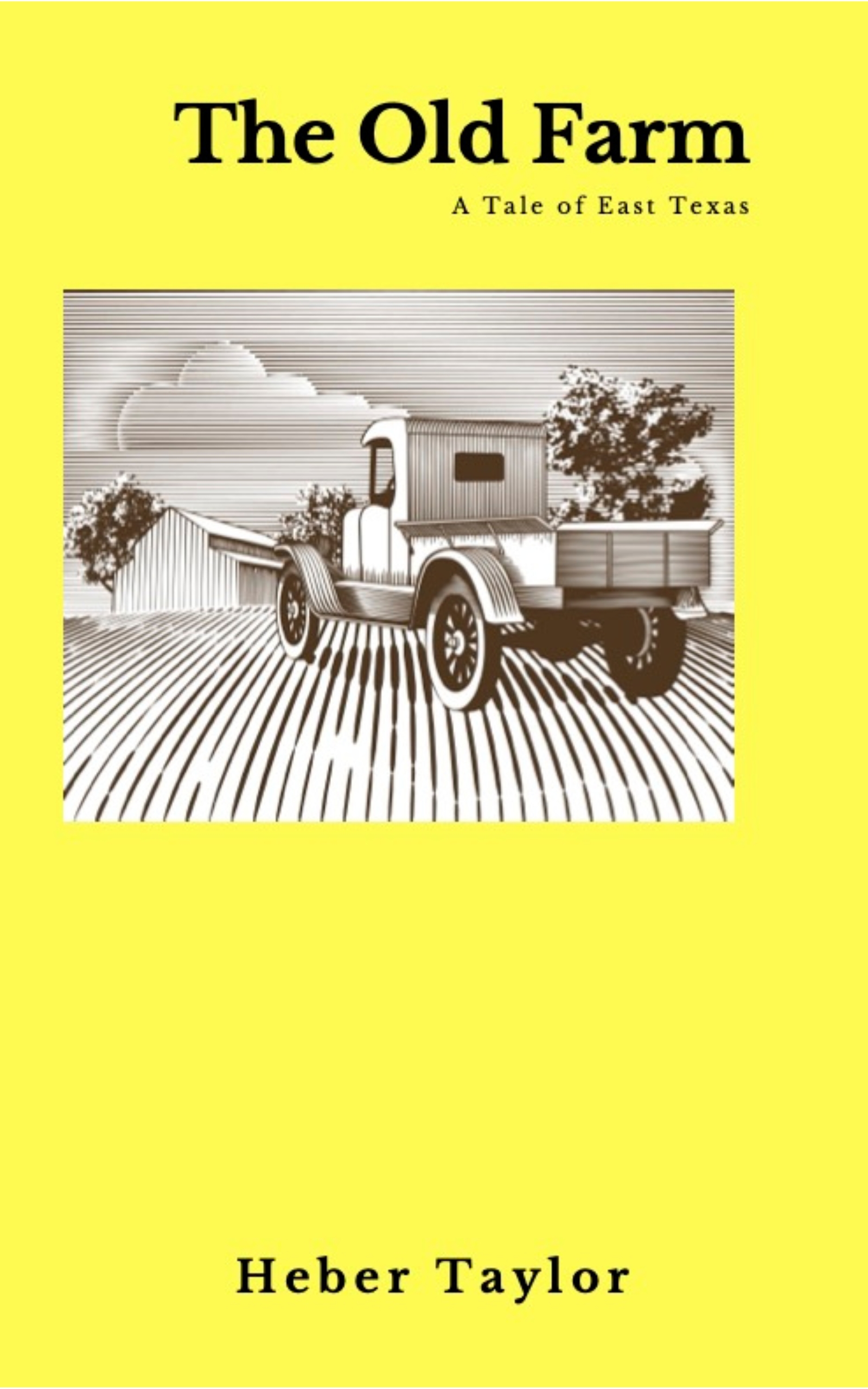
The Old Farm: A Tale of East Texas by Heber Taylor explores the life of an East Texas farmer and rancher making his way through myriad challenges while providing for a wife and family under dire economic circumstances. John Robert attends cattle auctions, raises chickens and cows and reminisces about his early life with Petey the raccoon. The story visits a time when lumber jacks, Model Ts and old sawmills were a part of the culture, and for John Robert and his family, visiting the famed Galveston Island was a rare treat.
The Old Farm: A Tale of East Texas (Books2Read) [ebook]
The Old Farm: A Tale of East Texas (Amazon Print)
An excerpt from the Old Farm: A Tale of East Texas
1. The Dream
John Robert first saw the farm when he was 55, but he saw it with the eyes of a young man. He saw the sign saying the property was for sale and killed the engine of the truck. He sat on the side of the road, a narrow, winding trail, topped with oil and asphalt, a far cry from the interstate highways that President Eisenhower was planning. A mist hung over the pastures, which were surrounded by the thick pine forests of East Texas.
John Robert found his package of Lucky Strike cigarettes and poured a cup of coffee from the Thermos bottle. He sipped the coffee slowly and he smoked slowly, taking in the land with his eyes.
It was, for the first time in his life, available to him. The feeling that came up was surprisingly strong, so strong it made him cautious, pushing him to the edge of fear. The fear was not of the land but what was inside him, the want, the need to have it, to make it his life’s work.
For three straight days he drove to the farm and sat beside the road and watched it. Each day, he left enough coffee in the bottle and enough time for a good smoke. At the end of the third day, he told Ruby, although by then she knew he was thinking about something. He had married her when he was 19 and she was 17, and Sally had come a year later. A decade passed before another daughter, Sue, arrived. But at the start, they had raised each other, Ruby would say. Now both daughters were married. Ruby and John Robert were alone.
Ruby knew when some project was in her husband’s mind. She knew by the way he rationed his coffee and tobacco. He was saving that for an occasion, for time, late in the day, when he could sit and think. She knew he had a plan that he was savoring, but she also knew that she must wait for him to tell her. And so it was as she cooked breakfast, and the kitchen smelled of coffee and sausage and toast, and the soft light poured in through the big east window, that he talked of the farm for sale on Corrine Road. Ruby, whose parents had been sharecroppers, never owning land, was surprised to hear herself say that she thought it would be all right.
Though he had sworn he would never do it again, John Robert borrowed money from a bank: $7,500 for 65 acres. The land had been cleared, perhaps 50 years ago, but it had been years since it had been tended. The place was covered with wild plum shoots, wiry little saplings that had to be dug out by hand.
And, to a thoughtful man, wild plums were as good as a neon sign, a warning that the land had been abused and that the soil was exhausted. The place had fallen from ruin to ruin until it had finally come into the hands of a family that had operated a carnival. John Robert, cleaning out the old barn, discovered a big tent, a thicket of abandoned electrical lights and an ancient shooting gallery, from which he salvaged one usable rifle that fired .22 shorts. The rest went to the dump, including a vast collection of empty whiskey bottles that were, in John Robert’s mind, the story of how the farm came to be owned by the bank.
The old house, which had never been luxurious, was ready in a week. John Robert hired two men to help him take things to the dump and a third to patch the roof. There was another week of fence fixing and general repairs and then John Robert and his youngest brother-in-law moved cows from a rented pasture to his own land. Ruby had the household goods packed, and they moved on a weekend so it wouldn’t interfere with her job. She was a seamstress and she worked in town at the factory that made women’s garments.
Though the farm was just three miles out of town, Ruby felt she was going into exile. The first night in the new house, she missed the sounds of town — a neighbor’s cat, a car horn, a late-night reveler with too much to drink. She cried, suddenly feeling that her life was in town and that it was over. But the sun came up the next morning and bluebirds sang as she had her coffee. She grew to love the quiet of the place.
They rose early — Ruby an hour before John Robert because she loved to watch the songbirds and tend to the cuttings she planted around the house. She had her coffee and read the paper and then fixed breakfast and their lunches. It took John Robert forever to get up. Then she drove to Margie’s, where she and 20 other women sewed undergarments together. John Robert spent the day digging plum shoots out of the old pasture. In the evening, he told her about the day when the grass emerged deep in the place where weeds and plum shoots grew now. He told how they would look out the back windows and see fat cattle on their land.
_____
All rights reserved. By payment of required fees, you have been granted the non-exclusive, non-transferable right to access and read this book. No part of this document may be reproduced or transmitted in any form or by any means, electronic, mechanical, photocopying, recording, or otherwise, without prior written permission of Heber Taylor or Narrativemagic LLC.
Copyright 2018.
Narrativemagic, LLC
Stone Mountain, Ga
ISBN: 978-0-9986416-9-0
The Old Farm and other books by Heber Taylor are published by Narrativemagic Press, Narrativemagic, LLC (narrativemagic.com).